




Count how many dollar-world things you touched before lunch today. The ride to work on a global app. The playlist in your ears. The coffee from a chain that started in Seattle. The laptop on your desk, running software from a company that earns, plans and budgets in dollars.
You paid for all of it in rupees, and that felt like the most ordinary fact in the world. Stretch it across ten years, though, and it stops being ordinary.
One life, two currencies
Most of us earn in one currency and aim in another. The salary, the business income, the rent coming in: all rupees. The things we actually want from life keep drifting toward global price tags. A child’s degree abroad. A proper holiday in Europe. The next phone, the next laptop, the software subscriptions that quietly became part of daily work. Even many everyday brands belong to global companies that think and budget in dollars.
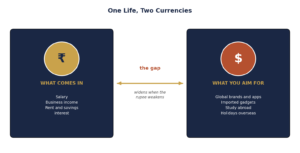
Income arrives in rupees while aspirations are priced in dollars, and the gap widens when the rupee weakens
On a calm day you never notice the mismatch. It sits in the background like a small leak, and the only way to see it is to compare two points far apart in time.
What ten years did to the rupee
In October 2016 a dollar cost about ₹66.7. In early October 2026 it costs roughly ₹96. Put plainly, the dollar is about 44% more expensive than it was a decade ago. Look at it from the rupee’s side and the rupee has lost about 30% of its value against the dollar, which works out to a little under 4% every year, compounding quietly.
Two examples make it real. A US university year that costs $50,000 was about ₹33 lakh in 2016 and is about ₹48 lakh today, with not a dollar of tuition inflation counted. And take ₹1 crore that sat untouched for ten years: it would have bought roughly $1,50,000 then, and buys about $1,04,000 now.
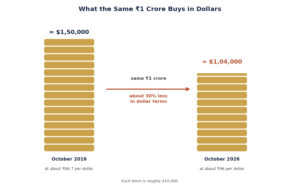
The same ₹1 crore buys about 30% fewer dollars in October 2026 than in October 2016
None of this is a freak event. India imports the bulk of its oil, runs a trade deficit, and has historically had higher inflation than the US, and each of those pushes the rupee the same way over time. The current backdrop adds a short-term push on top: US yields at multi-year highs and steady foreign investor outflows from Indian equities, both of which have kept the rupee under pressure this month.
Open your own portfolio and look
Pull up the list of everything you own. Mutual funds, stocks, fixed deposits, bonds, real estate, some gold. Almost all of it is a rupee asset. There is usually a small box labelled “global” or “international”, and in many portfolios that box is empty.
Gold deserves a fair mention. Because it is priced off international markets, it moves with the dollar to some degree, so it gives partial protection. But one asset, which pays no income, cannot be expected to carry the whole job. Real estate, often the largest slice of a family’s wealth, is a rupee asset that is also hard to sell quickly. So the typical picture is a household with a dollar-shaped future and a rupee-shaped balance sheet.
If you can’t earn dollars, let your money earn them
Some people fix the problem on the income side. They take on global clients, build an export business, or move to a role paid in foreign currency. If that is an option for you, it is the strongest fix there is. For most families it isn’t realistic in the short run.
Money, though, can earn dollars even when you can’t. That means owning global assets: overseas equities and funds, dollar-denominated bonds, and structured products linked to global markets. Indian residents can send up to $250,000 per person per financial year abroad under the RBI’s Liberalised Remittance Scheme for permitted purposes, including investments. For investment remittances, tax collected at source of 20% applies on the amount above ₹10 lakh in a year (the threshold went up from ₹7 lakh on 1 April 2026), and foreign holdings have to be reported in your income tax return. The rules, limits and tax treatment keep changing, so they need to be settled with a chartered accountant before the first rupee leaves.
What this is not
It is not a bet that the rupee will crash. Currencies swing both ways, and nobody can time them. It is also not a case for leaving India. Your domestic portfolio, your business, your property, all of it still matters.
Global assets carry their own risks too: market falls, currency moves in the other direction, and a different set of rules. The idea is narrower than a prediction. Match the currency of what you own with the currency of what you will eventually spend. If part of your future is priced in dollars, a part of your wealth should be able to answer in dollars.
That also tells you how big the global slice should be. It starts from your own goals, not from a rule of thumb: how much of what you plan to spend over the next ten or fifteen years is actually dollar-linked? Education abroad, travel, imported technology, a possible move overseas. Answer that honestly and the size of the slice becomes a sensible conversation instead of a guess.
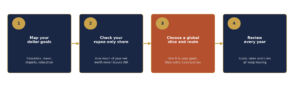
Four steps to build a global slice: map dollar goals, check the rupee-only share, choose a slice and route, review every year
The part worth repeating
Rupee depreciation doesn’t announce itself. There is no bill, no notice, no single bad day. It shows up as a US course fee that is quietly ₹15 lakh higher than it used to be, or a savings pot that buys a little less of the world each year. A rupee-only portfolio is a bet, even if it never felt like one.
Earn in rupees if that is where your life is. Just don’t let all of your money live there too.
Want to build this the right way, without guessing? The Fair Advice helps you build a global allocation around your own goals. You get verified, unbiased financial advisors and structured, principal-protected investment products, so that part of your wealth earns in dollars while the rest stays rooted at home. Start with one conversation about where your money sits today and where your goals are actually priced.
This article is for general information only and is not financial, investment, tax or legal advice. Exchange rates and rules cited here reflect early October 2026 and change often, including LRS limits and tax collected at source. Global investing carries market and currency risk. Please speak to a qualified financial advisor and chartered accountant before acting on any of it.