




Revenue tells you the business is growing. It doesn’t tell you whether the cash behind that growth is actually doing anything useful.
Most SMEs I’ve come across run their monthly review around the same four or five numbers, revenue, margin, receivables, expenses. Fair enough, those matter. But none of them answer the question that actually decides whether you survive a bad month: is there enough cash, sitting in the right place, at the right time, to cover what’s coming?
You can be profitable and still get blindsided. A customer pays 40 days late. A supplier suddenly wants advance payment instead of the usual credit terms. A tax deadline lands in a week you weren’t expecting it. Some cost nobody budgeted for just shows up. Meanwhile, a completely different business down the road might be sitting on a fat, comfortable bank balance doing absolutely nothing, while still paying interest every month on a loan it arguably didn’t need. Neither of those problems shows up cleanly on a P&L. Both of them are treasury problems.
So what does treasury management actually mean
Strip away the finance-speak and it comes down to this: treasury management is making sure your cash has a job to do.
Practically, that means knowing how much cash you actually have right now, how much you genuinely need to keep the lights on, when your big payments land, how fast customers are actually paying you (not how fast they’re supposed to), how much money is just sitting there doing nothing, and what risks could quietly chip away at your liquidity before you notice.
That job the cash needs to have could be covering day-to-day operations, sitting as a buffer for the bad month, paying off debt that’s costing you more than it should, funding whatever’s next, or, once it’s genuinely spare, being put somewhere sensible to earn something.
Start by actually seeing your cash, not guessing at it
Before anyone touches the question of surplus, you need a real picture of where cash is headed, not where it’s been. A rolling 13-week cash flow forecast does this well.
Instead of staring at last quarter’s numbers, you map what’s actually coming, week by week. Money coming in: customer collections, other receipts, anything you’re expecting from financing. Money going out: payroll, suppliers, rent, the usual operating costs, taxes, loan payments, anything you’ve already committed to spending on.
Once that’s laid out, you’re no longer guessing how much liquidity you need over the next few weeks, you actually know. From there you can set a minimum balance you won’t dip below, plus a bit extra as a cushion. Only after that should anyone even start using the word “surplus.”
The mistake nearly everyone makes without realizing it
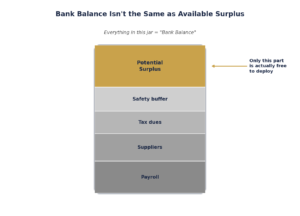
You check the balance, subtract what’s due today, and whatever number’s left just feels like it’s yours to use. It usually isn’t.
A chunk of that money already has somewhere to go, even if nobody’s written it down anywhere. Next month’s payroll. A supplier payment that’s due soon. Taxes. A loan installment. Equipment you already agreed to buy. Seasonal cash you’ll need in three months when things slow down. Or just the money you’d want on hand if something genuinely unexpected happened.
Bank balance is not surplus. If you want a cleaner way to think about it: take your closing cash, subtract the minimum you actually need to keep around, and what’s left is potential surplus. That word “potential” is doing real work there, because it still has to survive contact with whatever’s actually due and when.
Tracking how long money just sits there
Once you know your minimum operating number, you can start watching how much cash sits above it, unused, and for how long.
Say a business is carrying ₹25 lakh. The forecast says ₹15 lakh of that is genuinely spoken for, operations, buffer, the works. That leaves ₹10 lakh of potential surplus. If that ₹10 lakh just sits there for a month with nothing planned for it, that’s 30 idle days on ₹10 lakh, and now it’s something you can actually put a number on.
The math is simple enough. Daily surplus is your closing balance minus your minimum required balance. Track how long that surplus stays above the line, and over time you get a picture, average idle balance, average idle days, the longest stretch you ever let cash sit doing nothing, total idle fund-days, and what all that idle time actually cost you.
That’s the shift that matters. “We have cash in the bank” stops being the end of the sentence. The real question becomes how well that cash is actually being used.
What idle cash actually costs you
Idle money isn’t automatically a mistake, to be clear. There’s real value in liquidity. Having cash sitting around protects you against the thing you didn’t see coming. The problem is specifically when surplus just sits there, unallocated, for no particular reason, longer than it needs to.
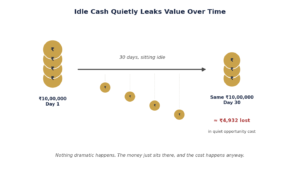
Here’s a rough way to put a number on it: take the idle amount, multiply by the days it sat idle, multiply by whatever yield you could’ve earned elsewhere, divide by 365.
Run that on ₹10,00,000 idle for 30 days at a 6% illustrative yield, and you land at roughly ₹4,932. On its own, that’s small enough to shrug off. The real question is what happens when that same pattern plays out across several accounts, bigger balances, and many months in a row. Small leaks add up, especially the ones nobody’s watching.
Where surplus cash should actually go
Once you’ve genuinely nailed down what’s surplus, the question isn’t “where do I get the best return.” It’s “when will I actually need this money, and what makes sense given that timeline.”
It really comes down to your liquidity needs and how far out you’re actually planning, and most of the time it lands in one of four places.
If you’ll need it soon, keep it liquid, don’t lock it up somewhere just because the rate looks a little better. If your borrowing is costing you noticeably more than your surplus cash could earn, paying that debt down is often the smarter move, just check the prepayment terms first. Genuinely spare capital can go toward growth, equipment, hiring, marketing, expansion, when there’s an actual strategic reason for it, not just because the money happened to be sitting there. And money that’s truly free of any near-term claim can be considered for low-risk, short-term instruments, depending on your goals, your appetite for risk, and where you’re operating.
The thread running through all of it stays the same: deploy cash based on what it’s for and when you’ll need it, not based on whichever option has the shiniest advertised return.
Safety comes first, and it’s not close
Operating cash isn’t the same animal as personal investment money, and treating it the same way is how businesses get into trouble. Most SMEs simply can’t afford to take real market risk with money that might be needed for payroll or a supplier next month.
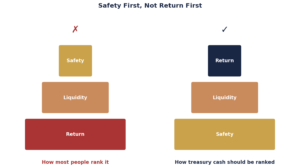
The order that actually makes sense is safety first, then liquidity, then return, not return first with liquidity as an afterthought, which is how a lot of businesses end up learning this lesson the hard way.
And before any of it moves anywhere, it’s worth actually understanding the lock-in period, how you’d get out if you needed to, who you’re exposed to, credit risk, interest-rate risk, the tax angle, and how liquid it really is when you need it to be.
Cash management is also risk management, whether you planned for that or not
Having enough cash today doesn’t mean you’re safe three months from now. Something outside your forecast entirely can quietly wreck a cash position that looked completely fine a month ago.
Deal with customers or suppliers overseas, and a currency swing can chip away at margins you thought were locked in. Got a loan on a floating rate? The moment rates move, your cash position feels it directly, no warning email included. A big customer paying late, or not paying at all, can wreck working capital fast, this one’s blunt and it happens constantly. And weak payment controls or outright fraud create losses that were entirely avoidable, if someone had actually been watching.
Treasury isn’t just about knowing where your money is right now. It’s about knowing what could change how much of it is actually there when you go looking for it.
The numbers worth actually tracking
A treasury process only means something once you’re measuring it, not just talking about it in principle. A few things worth actually watching:
- Cash runway. How long your money on hand would actually last, if you’re honest about the assumptions.
- DSO (days sales outstanding), how fast customers are really paying you.
- DPO (days payable outstanding), how long you’re actually taking to pay your own suppliers.
- Cash conversion cycle, how long your cash stays locked up between paying for something and getting paid for it.
- Average idle balance, how much surplus typically just sits there on any given day.
- Idle days, how long that surplus goes unallocated.
- Opportunity cost, roughly what all that idle time is actually costing you.
Track these consistently, month after month, and treasury stops being something you think about occasionally and becomes an actual discipline, the same way you already track sales or margin.
What this is really all about
None of this was ever about investing every rupee you have, or keeping the fattest bank balance possible, or chasing whatever return looks best on a flyer. It’s about actually seeing your own capital clearly and having some control over it.
A treasury process that’s working lets you answer five things without much thought: what cash do I have, what do I actually need, what’s genuinely surplus, how long has it been sitting there doing nothing, and what’s the smartest thing to do with it.
Get in the habit of answering those consistently, and cash stops being just a line on a balance sheet somewhere. It starts being something you’re actually steering, instead of something that just happens to you every month.
The Fair Advice Perspective
At The Fair Advice, treasury management isn’t a side topic, it sits right inside how we think about business performance and wealth creation as a whole. This was never just about pushing revenue up and hoping the rest sorts itself out.
Cash flow, profitability, capital, risk, the bigger financial calls you make, none of it lives in its own little box on a spreadsheet. It’s all one system, moving together whether you’re watching it or not. For an SME, that usually comes down to a few things: finding where cash is actually getting stuck, working out what idle capital is quietly costing you, getting real visibility into your own liquidity instead of vague guesses, and actually deciding what happens to surplus funds instead of letting default settings decide for you.
Because better visibility into your cash leads, pretty directly, to better decisions about your capital.
The Fair Advice. Where better decisions create better profits.
This is general information, not financial, investment, tax, or legal advice. What applies to your business, the products, the liquidity, the tax treatment, all of it depends on where you’re based and who you’re working with. Check with a qualified professional before acting on any of this.