




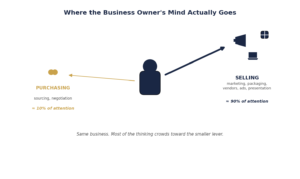
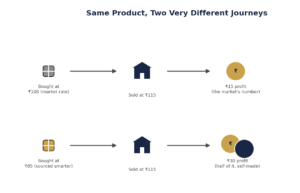
Watch how a business actually spends its attention on any given product, and you’ll see something strange. Someone buys a product for ₹100. The market rate to sell it is ₹115. That’s a ₹15 margin, and suddenly the entire team lights up. How do we market this. What should the packaging look like. Which vendor handles the listing. Do we need a better digital presentation. Should we run ads. Ninety percent of the thinking, the meetings, the energy, goes into that ₹15.
The purchase, the ₹100 that started the whole thing, barely gets a conversation. It just happens. Someone calls the usual supplier, agrees to the usual rate, moves on to the more exciting part of the job.
That’s backwards, and it’s costing businesses a lot more than most owners realize.
Where the real money actually sits
Here’s the uncomfortable arithmetic. Buy at the same rate everyone else buys at, and that ₹15 margin was never really yours. It’s the market’s number, and your business just happens to be standing where it lands. Your competitor has access to the exact same ₹15. The only way it turns into something you actually own is if you find a way to get that ₹100 item for ₹85 instead. That’s not the market’s money anymore. That’s money you made, through sourcing, negotiation, timing, a relationship somewhere, all of it happening before the sale ever entered the picture.
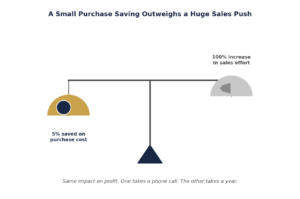
Procurement research actually backs this up, and the numbers tend to surprise people the first time they see them. Cost of goods usually eats up somewhere between half and ninety percent of what a business spends in total, so even a small saving on the buying side moves profit more than you’d expect from pushing harder on sales. One comparison people in the field use a lot: cut what you pay for materials by just 5%, and the EBITDA impact can be worth more than doubling, the kind of gain you’d otherwise need a full 100% jump in sales just to match. A rupee saved on a purchase often has to be chased down by twenty, thirty, sometimes forty rupees of new sales just to have the same effect on what actually lands in the bank.
That’s not a small distinction. That’s most of the game, sitting quietly in the one meeting nobody ever bothers to schedule.
Why everyone still spends their energy on the wrong side
Selling feels like the real work, mostly because it’s visible. You’re talking to customers, running campaigns, watching numbers move while you watch. There’s a kind of rush to closing a sale that negotiating a purchase price just doesn’t give you. Purchasing looks administrative by comparison. A phone call, a message to the usual vendor, an invoice that gets filed away. Nobody’s putting “renegotiated supplier terms” on a highlight reel anytime soon.
The market for selling is also just genuinely harder to move than people assume. Everyone in your category is fighting over the same customer’s attention, and the ceiling on what you can charge gets set by the market itself, by your competitors, by what people are actually willing to pay. You can throw an enormous amount of effort at selling and still only shift your margin by a rupee or two, because that whole side of the business is a crowded room where everyone’s already shouting.
Purchasing gets far less competition for your attention, which is exactly why it’s underused, and exactly why the real edge still sits there. Two businesses can sell the identical product at the identical price and end up with wildly different profitability, purely because one of them bothered to find a supplier, a bulk deal, a relationship, a sourcing route the other one never went looking for.
What this looks like in practice
The fix isn’t complicated, but it does require treating purchasing like the strategic function it actually is, not the errand it currently gets treated as.
Ask where else this could come from. If you’re paying the market rate for something, the honest question isn’t “how do I sell this well.” It’s “is there a place this same thing is available for less, and why haven’t I found it yet.” Alternate vendors, different regions, bulk arrangements, direct-from-manufacturer routes, all of these exist for most products. Most businesses simply never go looking.
Negotiate like the number matters, because it does. A 5% saving on your purchase price isn’t a rounding error. Based on how procurement economics actually work, that 5% can be worth more to your bottom line than a much larger jump in sales volume. Treat every purchase renegotiation with the same seriousness you’d give a major sales pitch, because pound for pound, it often matters more.
Rebalance where your best people spend their time. If your most capable person is spending ninety percent of their week on marketing a ₹15 margin and ten percent on the ₹100 purchase decision underneath it, that allocation is fighting the actual math of the business. Flip it, even partially, and watch what happens to the number that actually lands in the bank.
Track cost of goods with the same discipline you track revenue. Most businesses have a sales dashboard everyone checks daily. Far fewer have anything close to that same visibility on what they’re actually paying to acquire what they sell. You can’t improve what you’re not measuring, and most businesses aren’t measuring the half of the equation that moves the needle most.
Why this matters beyond any single transaction
This isn’t really about one product or one supplier. It’s about where a business chooses to point its attention, quarter after quarter. A business that keeps investing its best thinking into selling will keep fighting the market for scraps of margin the market was never going to give up easily. A business that invests real thinking into purchasing is building an advantage competitors genuinely can’t see and can’t easily copy, because it’s happening upstream, before the product ever reaches a customer’s eye.
The businesses that consistently outperform their category on profitability, not just revenue, tend to be the ones that took procurement seriously long before it was fashionable to talk about. The margin was never really made at the register. It was made, or given away, at the purchase order, weeks earlier, quietly.
The real point
Profit isn’t manufactured by a great sales pitch. It’s protected there, at best, if the buying decision underneath it was actually sound. Spend the next quarter running the same audit on your purchasing that you already run on your sales, who you’re buying from, at what price, with what leverage, and see what that ₹15 margin actually turns into once the ₹100 underneath it stops being an afterthought.
If you’re an MSME or a startup and this “purchase over sale” idea just made you rethink where your team spends its time, that’s exactly the kind of gap worth fixing with the right guidance, not guesswork. The Fair Advice works directly with MSMEs and startups on business consulting to build this discipline into how you buy, and pairs it with a wealth creation and wealth optimization solution for the surplus profit it generates, so the capital you free up through smarter purchasing has a real, structured place to grow. One conversation covers both: how to fix the entry point in your business, and how to put what you save to work.
This article is for general information only and isn’t financial or business advice. Please consult a qualified professional before making structural, procurement, or financial decisions specific to your business.